
Latest events
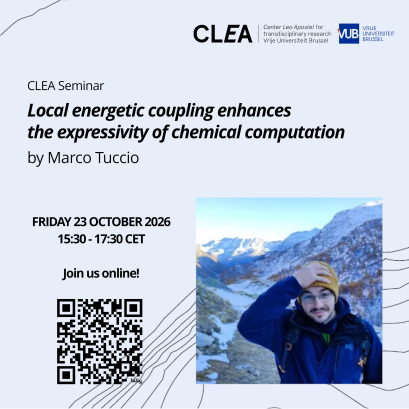 Practical info23/10/2026 - 15:30 - 23/10/2026 - 17:30
CLEA Seminar - Local energetic coupling enhances the expressivity of chemical computation - By Marco Tuccio
Chemical reaction networks can compute nonlinear functions at steady state. By inverse-designing the free-energy landscape with implicit differentiation, we show that expressivity scales logarithmically with network size, tracking reaction count. Of all tunable parameters, nonequilibrium thermodynamic drives, which break detailed balance, are the most effective single resource.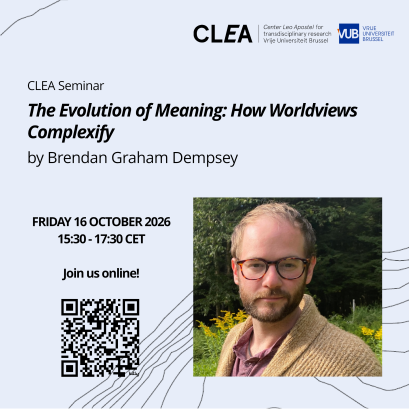 Practical info16/10/2026 - 15:30 - 16/10/2026 - 17:30
CLEA SEMINAR - THE EVOLUTION OF MEANING: HOW WORLDVIEWS COMPLEXIFY - BY BRENDAN GRAHAM DEMPSEY
Does meaning have a place in the physical universe? This talk argues from The Evolution of Meaning that meaning and value arise from thermodynamic and evolutionary processes, as open systems learn about their environments to persist. It then measures the growing complexity of individual and cultural worldviews, from Tribal to Integrative, using the Lectical Assessment System, and considers the metacrisis and AI.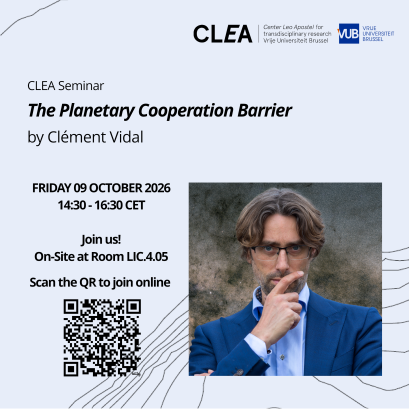 Practical info09/10/2026 - 14:30 - 09/10/2026 - 16:30
CLEA Seminar - The Planetary Cooperation Barrier - By Clément Vidal
This paper introduces the "planetary cooperation barrier": a multidimensional deadlock across geological, biological, cultural, and institutional domains that blocks Earth's spheres from integrating into a viable, cooperative system. Combining Beer's Viable System Model, major evolutionary transitions, and evolutionary game theory, it diagnoses the pathologies sustaining the barrier. It frames planetary governance as a solvable design problem, requiring constrained sovereignty, altered payoffs, and enforceable architectures, and examines the IMF and Montreal Protocol as precedents.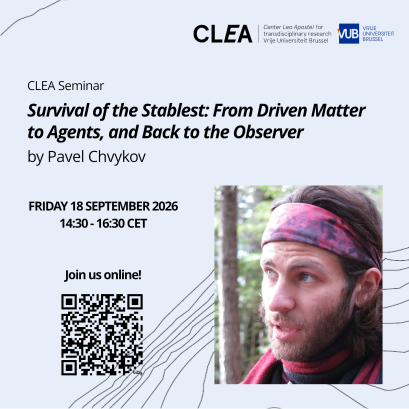 Practical info18/09/2026 - 14:30 - 18/09/2026 - 16:30
CLEA Seminar - Survival of the Stablest: From Driven Matter to Agents, and Back to the Observer - By Pavel Chvykov
In this talk, Pavel Chvykov argues that away from equilibrium no local quantity predicts a system's fate — until "low rattling" theory recovers prediction by trading generality for accumulation-where-slow-to-leave. He traces this from thermodynamic self-organization through Bayesian-readable systems to agency as observer-relative causal description, ending self-referentially with implications for science and mind. Practical info28/08/2026 - 10:00 - 29/08/2026 - 17:00
LEAP Conference 2026: Transitions in Epistemic Paradigms
The first LEAP Conference will bring together CLEA and LEAP students, senior researchers, and invited speakers for a program of talks, discussion, and collaboration.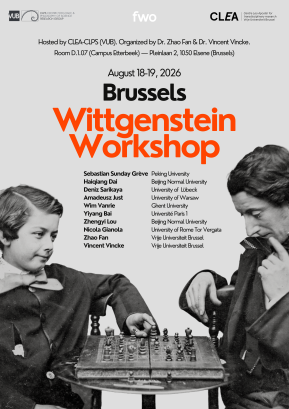 Practical info18/08/2026 - 13:00 - 19/08/2026 - 17:00
Brussels Wittgenstein workshop
Hosted by CLEA–CLPS at the Vrije Universiteit Brussel, the inaugural Brussels Wittgenstein Workshop brings together young and emerging scholars working on different aspects of Wittgenstein's philosophy.


NEW LARGE RESEARCH GROUP CLEA-CLPS
From 2024, the VUB research centres CLEA and CLPS (Centre for Logic and Philosophy of Science) have been integrated into a large research group, called CLEA. Prof. Karen François was appointed general director, while former CLEA head Prof. Francis Heylighen became research director. You can consult the entire new directing team here. While initially, both CLEA and CLEA-CLPS have continued to communicate through their existing channels, both are now gradually being integrated here. Meanwhile, the story of CLPS up to the merger remains available on its old website.
WHO ARE WE?
The Centre Leo Apostel (CLEA) is a transdisciplinary research centre at the Vrije Universiteit Brussel (VUB). CLEA’s mission is to bridge the different scientific, social and cultural disciplines. It was founded as in interfaculty unit in 1995 under the impulse of the Belgian philosopher Leo Apostel (1925-1995), who formulated its goal as the integration of the different disciplines into a coherent worldview, so as to counteract the current fragmentation into ever more specialized approaches. Next to worldviews, our research has addressed fundamental interdisciplinary issues, including complexity, systems, evolution, quantum entanglement, cognition, artscience and well-being.
CLEA's research philosophy is "thinking beyond boundaries". Thanks to this, it has attracted and trained a large number of talented researchers from the humanities, social sciences, physical sciences and engineering, representing countries from across the globe. CLEA is now internationally recognized as a unique, transdisciplinary research centre with a steady output of high-level, innovative publications. Next to research, CLEA offers diverse educational programs and activities, including an interdisciplinary PhD, the School of Thinking postgraduate, courses, and public seminars and lecture series.
The Centre for Logic and Philosophy of Science (CLPS) was founded in 1998 by its first director Jean Paul Van Bendegem as a research unit within the Philosophy Department of the Faculty of Humanities and Languages. Research within CLPS has been mainly organized around two clusters: one on the development of a descriptive, empirically informed, philosophy of mathematics or "philosophy of mathematical practices", and one on the history and philosophy of early modern science and scientific method (with a particular focus on Newton's work and legacy). The interdisciplinary nature of much of this work has lended plausibility to the CLEA-CLPS merger, seeking reinforcement through enhanced intellectual exchange.
News

School of Thinking: Open-door session, Monday 8 September, 2025
Final weeks! As the 2025–2026 academic year approaches, we would like to put the School of Thinking Edition Tau back on your summer radar.

